
Neuroscience
The computational principles of perception, memory and behaviour, drawn from the brains that exhibit them.
Our work in neuroscience proceeds from a simple premise: intelligence, at present, is best characterised in the natural systems that exhibit it. We are interested in how information is represented in the brain; in how those representations issue in behaviour; in the computational principles underlying perception, memory and learning; and in the constraints (biological, physical, theoretical) any plausible account of the mind must respect. The resulting questions are, by their nature, interdisciplinary, sitting between systems and computational neuroscience, cognitive science and the formal sciences. Our role, more modestly, is to convene the people who hold pieces of the answer and to keep them in sustained correspondence.
- How is information represented in the brain and how do those representations generate behaviour?
- What computational principles underlie perception, memory and learning?
- What is the role of neural circuits in cognition and where applicable in consciousness?
- Which biological constraints and which useful abstractions, should inform a theory of intelligence?
- Where do discoveries in artificial intelligence advance our understanding of the brain and where do they not?
Conferences
Neuroscience is the second through-line of our work. At the Conference on the Mathematics of Neuroscience and AI we examine the biological, mathematical and computational foundations of intelligence: submission-led, peer-reviewed, oriented toward open problems. At the AE Global Summit, the same questions meet the institutions, applications and governance structures that surround them.
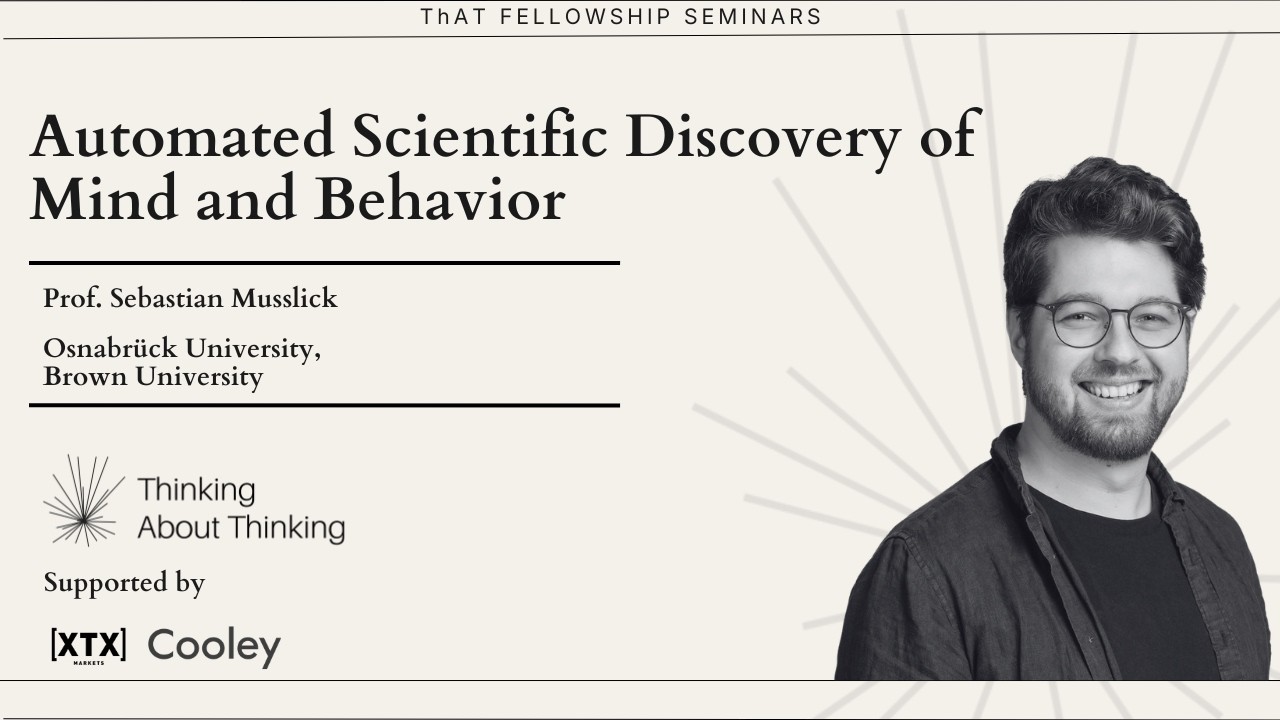
Fellowship Seminars:Automated Scientific Discovery of Mind and Behavior with Prof. Sebastian Mußlick
For our first session, Prof. Sebastian Mußlick will present a framework for automated scientific discovery in cognitive science, exploring h…
Watch →
Panel Discussion - "Open Problems in Computational Neuroscience"
Panel discussion on the topic of “Open Problems in Computational Neuroscience” Panel guests: Dr James Whittington (Chair) Professor Wolfgang…
Watch →
Mood as a vehicle of reinforcement learning (Professor Eran Eldar)
Professor Eran Eldar presents "Mood as a vehicle of reinforcement learning" Abstract - The science of learning and decision-making has large…
Watch →
Spotlight- Dynamical systems principles underlie the ubiquity of biological data manifolds
Spotlight talk by Dr Arthur Pellegrino presents "Dynamical systems principles underlie the ubiquity of biological data manifolds" Abstract -…
Watch →
Spotlight- Estimating flexible across-area communication with neurally-constrained RNNs
Spotlight talk by Philipp Werthmann presents "Estimating flexible across-area communication with neurally-constrained RNNs" Abstract - Previ…
Watch →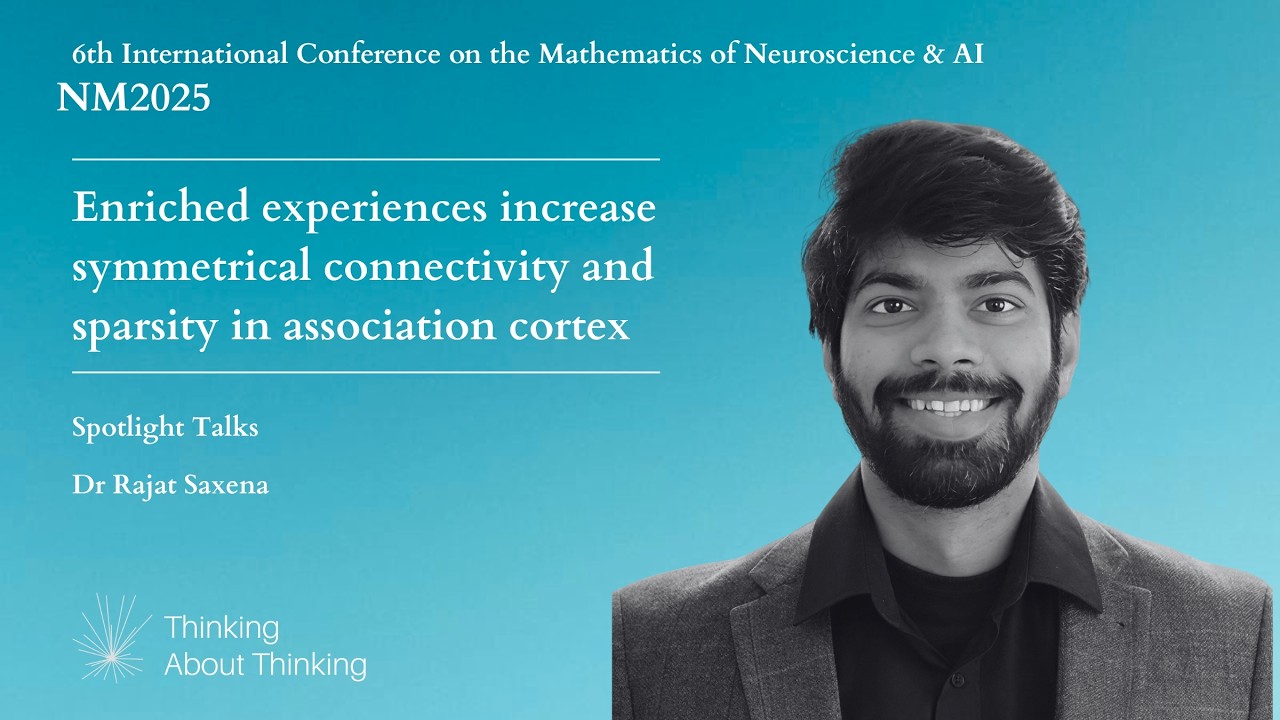
Spotlight- Enriched experiences increase symmetrical connectivity and sparsity in association cortex
Spotlight talk by Dr Rajat Saxena presents "Enriched experiences increase symmetrical connectivity and sparsity in association cortex" Abstr…
Watch →ThAT Ambassador Programme
The Thinking About Thinking Ambassador Programme is an open, application-based pathway for students and early-career researchers who wish to take part in serious, interdisciplinary conversations about intelligence. Ambassadors support our conferences, workshops, and community initiatives; in turn, they help to extend thoughtful dialogue across universities, disciplines and countries. The programme is designed for those who care, in earnest, about ideas, collaboration, and the construction of intellectual community.
Outstanding ambassadors who, over time, demonstrate sustained contribution, leadership and intellectual engagement may, in due course, be invited into the Thinking About Thinking Fellowship, a private, invitation-only programme reserved for long-term contributors to the work.